
A winning netball season | Redmaids' High School
Date Posted: 12 March, 2020
READ MORE
 Redmaids' High School recently received a prestigious partnership grant from the Royal Society, working with the University of the West of England, to launch a project using eDNA technology to identify species living in Bristol’s rivers.
Led by our fantastic Biology teacher, Mrs Turner, the project will give a group of students the opportunity to take part in laboratory and fieldwork over the coming months. Together, they will study the biodiversity of the River Trym and investigate ways to help protect and improve local wildlife populations. This partnership is a wonderful example of how education and scientific research can come together to inspire young people and deepen their understanding of the natural world; it is fantastic that our students will be contributing to real-world conservation work while developing their scientific skills and experience.
The first day of the project took place last week. Here is a report from Mrs Turner...
The day started with a torrential downpour as everyone arrived at school, but thankfully cleared to sunny skies by the afternoon, ready for us to start our sampling. Students started the workshop with a talk from Associate Professor Mark Steer (who runs the Conservation Science department at UWE). He talked them through the process of eDNA sampling and testing and its importance for conservation projects. The insightful questions from our Year 12’s led him into degree level content on the use of quantitative PCR.
Then Amy Wade (River Education and Engagement lead at BART) led the students through the issues facing our local river Trym and the Hazel Brook. Students were fascinated with the amazing life cycle of the critically endangered European Eel which breed in the Sargasso Sea before migrating all the way across the Atlantic to the rivers of Europe, and even our own little Trym! Our Year 10 students had a long discussion with one of the PhD students from UWE about the eel, and she was so impressed with their questions and enthusiasm.
 Students used what they had learnt from the fascinating talks to start planning their investigation and settled on a title of "How do the weirs and culverts of the Trym and Hazel Brook affect the fish species distribution?". From this point they got into planning their method and identified several different survey points along the river which they would like to visit. It was so inspiring to see the students working together and rising to the challenge of planning their own field investigation, an impressive feat.
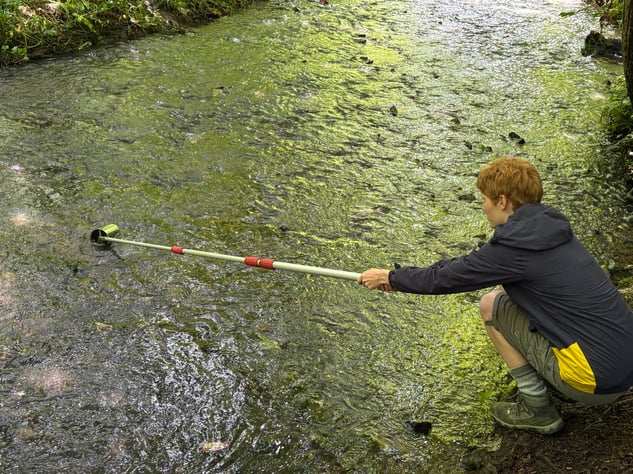
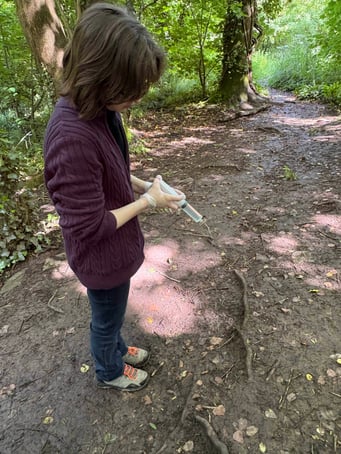
Having decided on their plan we set off into the field. Our first stop was Badocks wood where the PhD and Masters students from UWE demonstrated how they use the equipment to take samples of water from the river before syringing it over a specialised filter system to collect and preserve the DNA in the sample. These samples will be stored at UWE over the summer before we start the DNA extraction and analysis in September.
In the afternoon we headed off to Blaise estate, at each site the students identified the human made features they wanted to investigate, laid out tape measures to ensure systematic sampling and carefully collected and labelled their samples. Superb young scientists showing skill and dedication in their work!
Before we knew it we were out of time and headed back onto the bus to return to school.
One of the highlights for me as their teacher was to see how confidently they interacted with Mark (Associate professor), Robyn (PhD student) and Dylan (Master student) from UWE. Our students really made the most of this opportunity and worked with such engagement and enthusiasm, they can be very proud of everything they accomplished in just one day.
We left excited for our DNA day in September where we will extract the eDNA from our samples. Students will then be taught how to prepare the samples for PCR analysis where we will be looking for the presence of Eel, Brown trout, and Stickleback. Amy, from BART, pointed out that this study is certainly not just your ordinary school science project and the results will be used by the Rivers Trust as they continue their work to improve the condition of our beautiful local rivers.
It was a fantastic start to the project. The next stage will take place in September when Mark and the team will be coming into school for the day and taking over one of our labs! Students will be taught how to use the equipment to extract the environmental DNA from the samples which they have just collected. These will be incubated for two hours and then we will use the quantitive PCR machines to identify the presents of the eDNA from their chosen species. Look out for more updates in September!
Mrs Turner, Biology Teacher
-1.png?width=770&name=Untitled%20design%20(27)-1.png)